Behavioral health
Your directors and your finance team report the same number.
Your EHR, billing, payroll, and care planning systems each count the same month of work in their own way, and a monthly report reaches you weeks after the fact. Newtack brings their data into one place, where each number follows a definition agreed with the staff who enter the data and written down once before the number reaches a screen. You see delivered care hours, submitted charges, and denied claims while the month is still open.
Newtack runs this today at a multi-state, multi-service community-based behavioral health provider.

What separate systems cost you
Your EHR's own reporting is built for the EHR. It cannot answer a question that needs payroll, billing, and care planning in the same number.
Your numbers do not agree
Your EHR records visits and notes, your billing system records claims, and payroll records the hours staff worked. The number a regional director gives you on Monday morning does not match the one finance reports, and the meeting goes to reconciling them instead of deciding anything.
You find out after it has cost you
A monthly report shows you results weeks after the fact. By the time it reaches you, a staffing gap or a run of denied claims has already been paid for.
You cannot see what is happening this week
Someone has to pull a report to learn whether clients are receiving the care hours in their plans, or how much of your clinicians' time goes to care.
You negotiate rates without your own numbers
You go into a payer meeting knowing the rate you need, with no service numbers in front of you to support it.
You decide staffing on instinct
You decide where to add clinicians and which program to grow without a count of demand and staff capacity that everyone accepts.
Your systems' data, together in one set of numbers
Most ways of getting one set of numbers start with the software. A reporting tool is bought and a part-time analyst is asked to feed it, or a firm is hired to build reports on the data as it stands. Either way the definition of a number stays where it has always been, in each system and in each director's head, so the first time finance and a director disagree, the argument starts again. An EHR's own reporting covers the EHR, never payroll, billing, or care planning, and that gap between systems is where Newtack works.
Newtack starts with the definitions. Before a number reaches a screen, the staff who enter the data agree what it counts, for example whether an attempted call counts as a contact or only a completed one, and that rule is written down once and shown next to the number. When a rule turns out to be wrong, it is changed in one place and every view recalculates.
Your directors keep their own spreadsheets through setup and check our numbers against them. After that, the spreadsheet is a check on the number and no longer the place the number comes from.
What leadership and program directors see
"Live dashboards, outcome data at the table, vacancy and utilization seen in advance, capacity and assessment gaps."

Leadership overview
Active clients, completed visits, care plan fulfillment, clinician utilization, submitted charges, and notes signed on time, each against the previous period or the same period last year. Filter by service area, location, program, and clinician to find the part of the organization that needs attention.
Care delivery
The hours a program planned against the hours it delivered, by program, location, and clinician, down to the single visit. For services billed by the hour, a planned hour that is not delivered is also an hour that is not billed. Planned hours with no clinician assigned show where a program is short of staff.
Trends and pacing
Completed visits, delivered hours, submitted charges, and active clients against the previous period or last year. Partway through a month, pacing shows whether hours and charges are on track, so a director can step in before the month closes.
Revenue by period
Submitted charges and claims by month, the mix by payer, and denied charges by reason, down to the individual claim.
Documentation
The share of notes signed within 48 hours of the visit, the notes coming due, and the overdue notes listed by clinician, so a supervisor can follow up by name.
Ask in plain language
Choose a question from a list, such as whether clients are receiving the care their plans call for, and get the figure, the view it comes from, and the definition behind it. Each answer follows the same metric definitions as every view, because it reads from the same place.
See it running on sample data
The demo behaves the way the product does, so you can see the views before any of your own data is involved. It runs on sample data built for the demo. You can filter, compare periods, drill down to a single visit, and export what you see. Nothing you do changes a record.
Open the demoIf you direct a program, the demo is the fastest way to see what your leadership would be looking at.
-
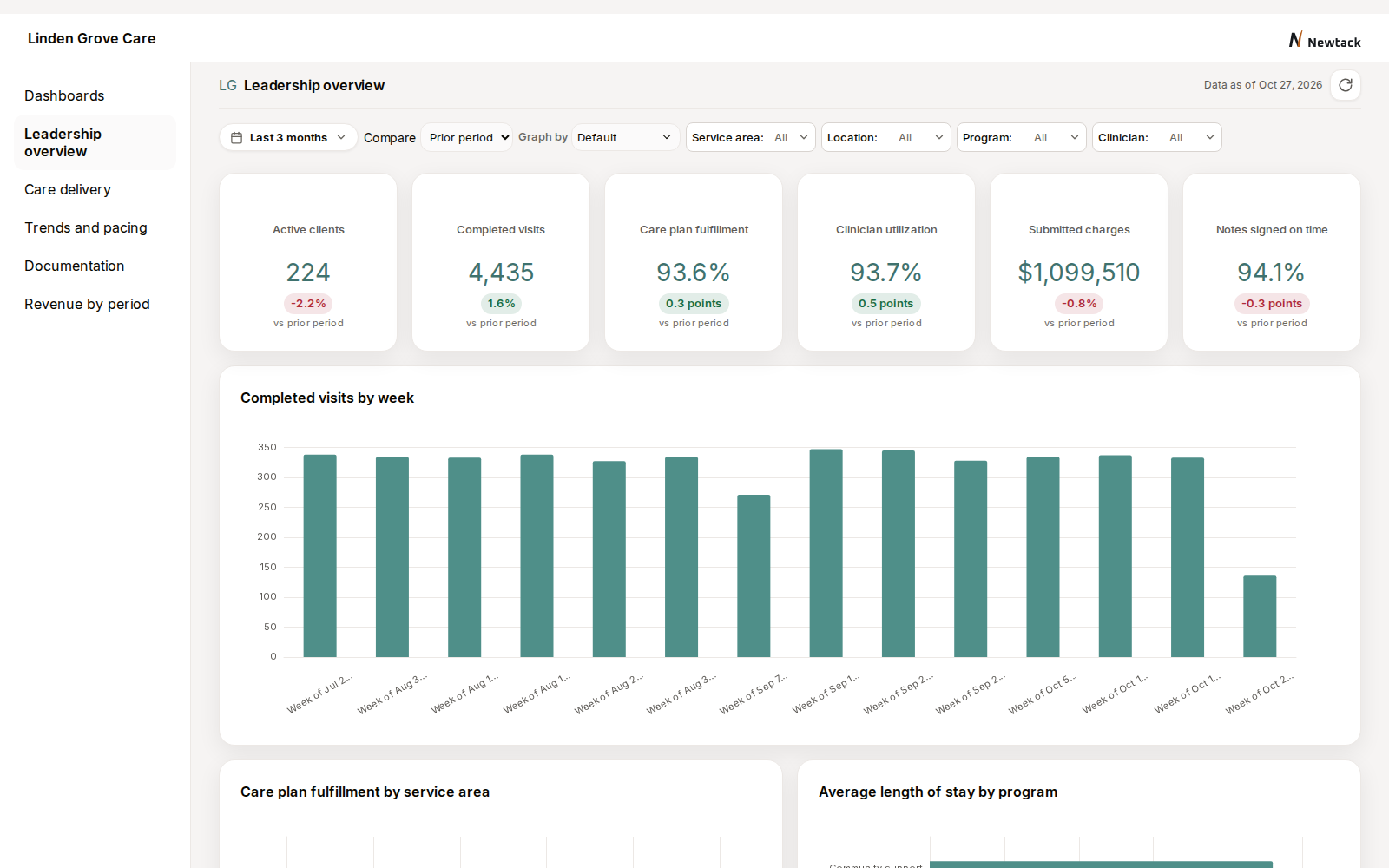
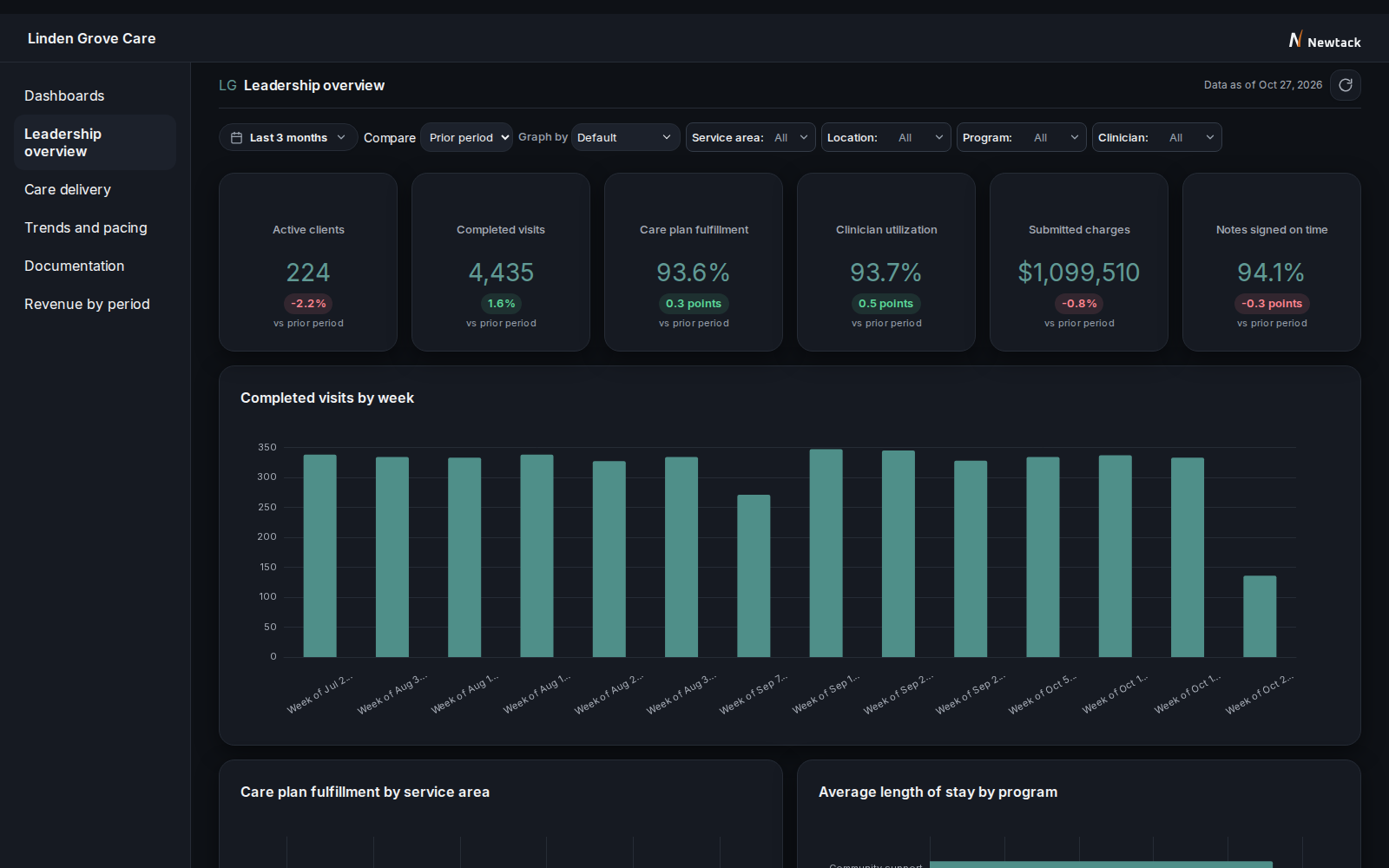
Leadership overview -
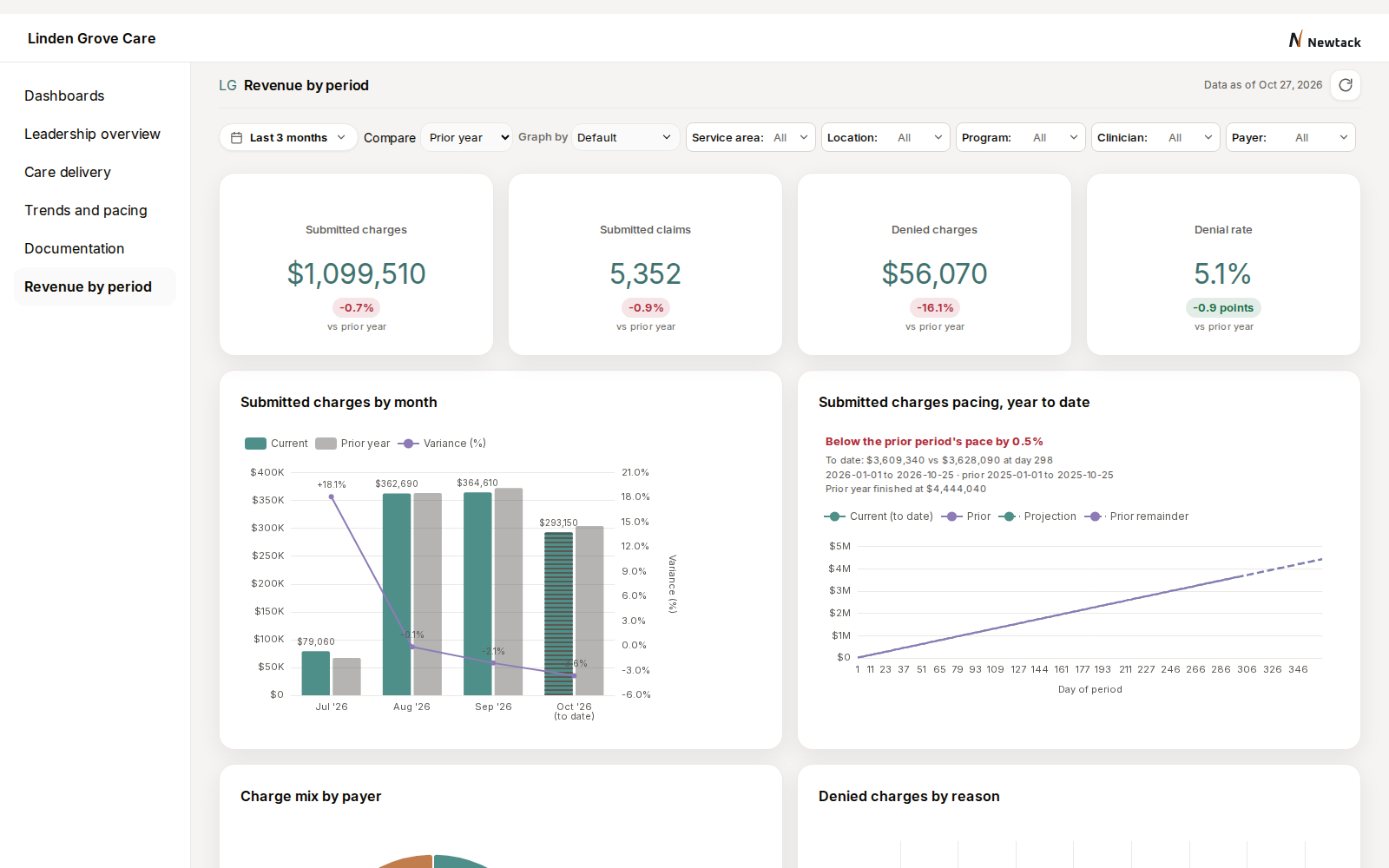
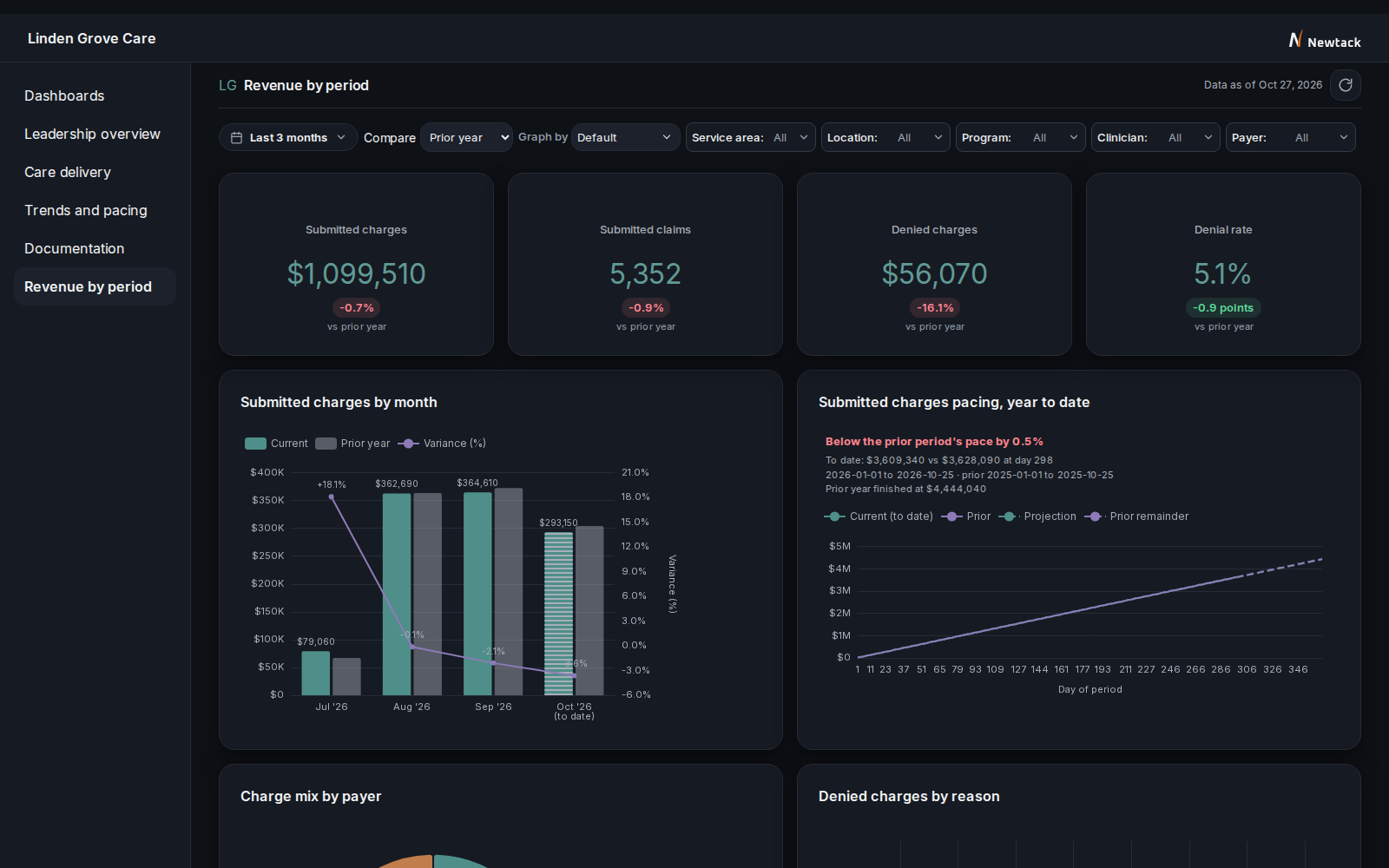
Revenue by period -
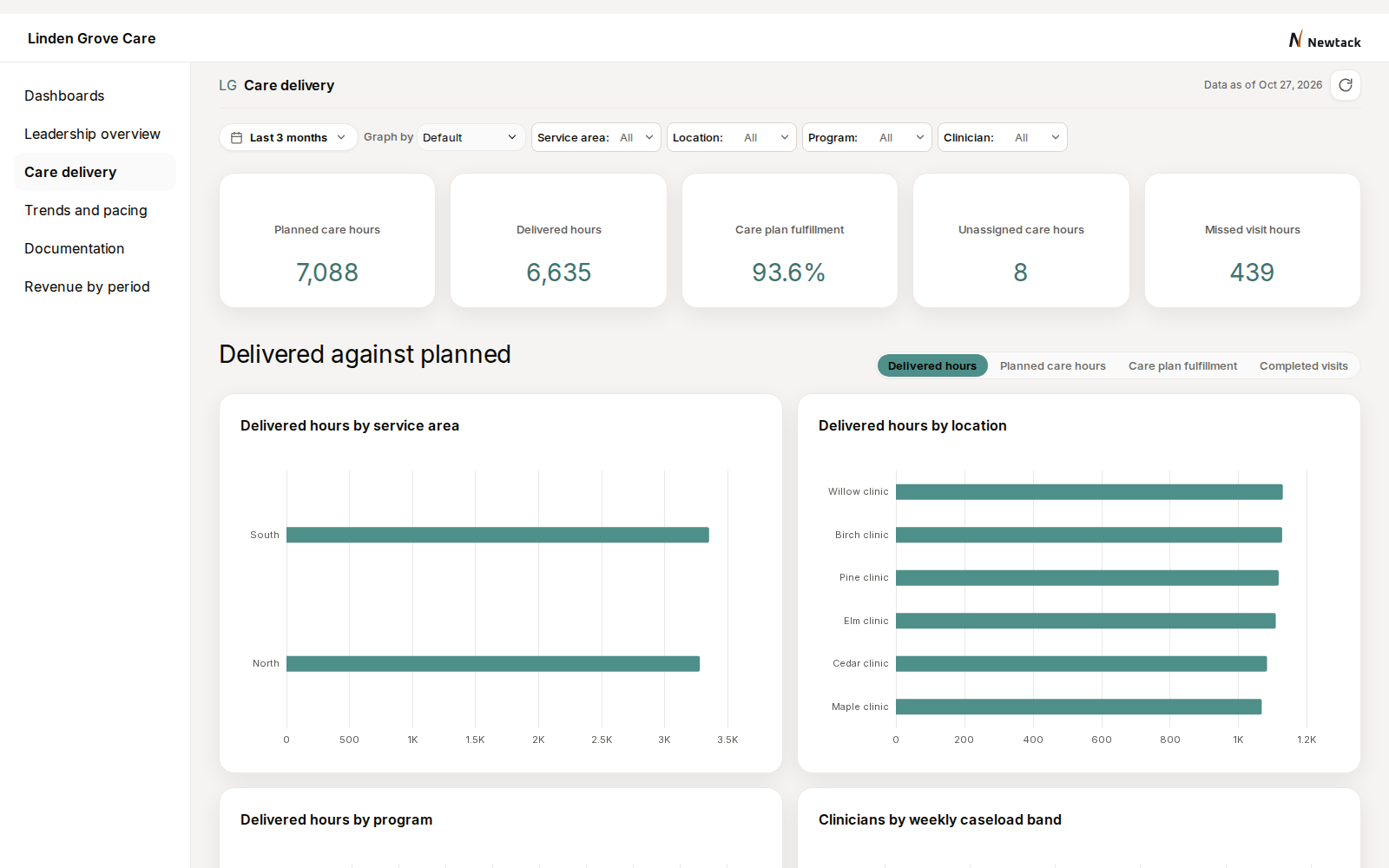
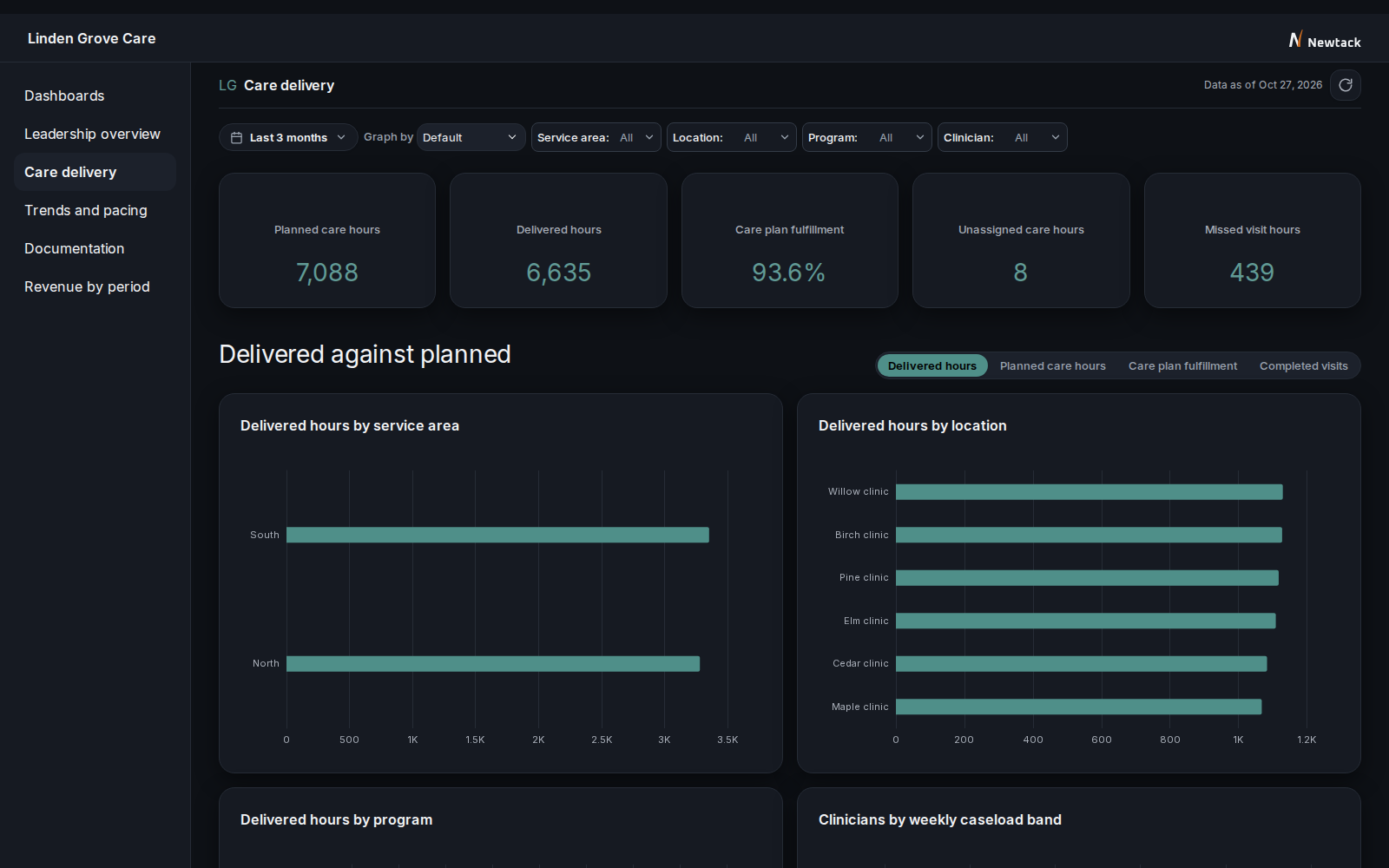
Care delivery -
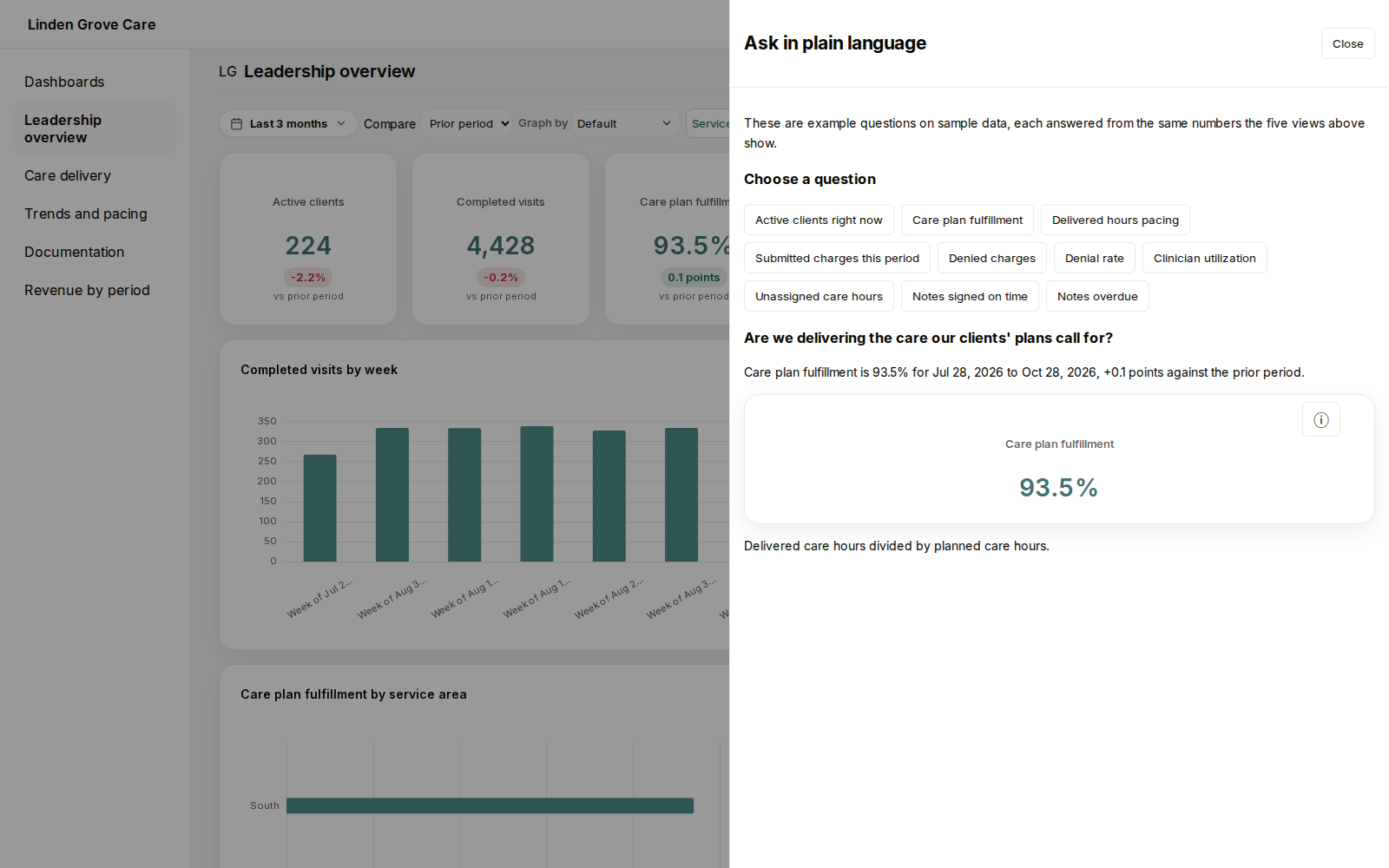
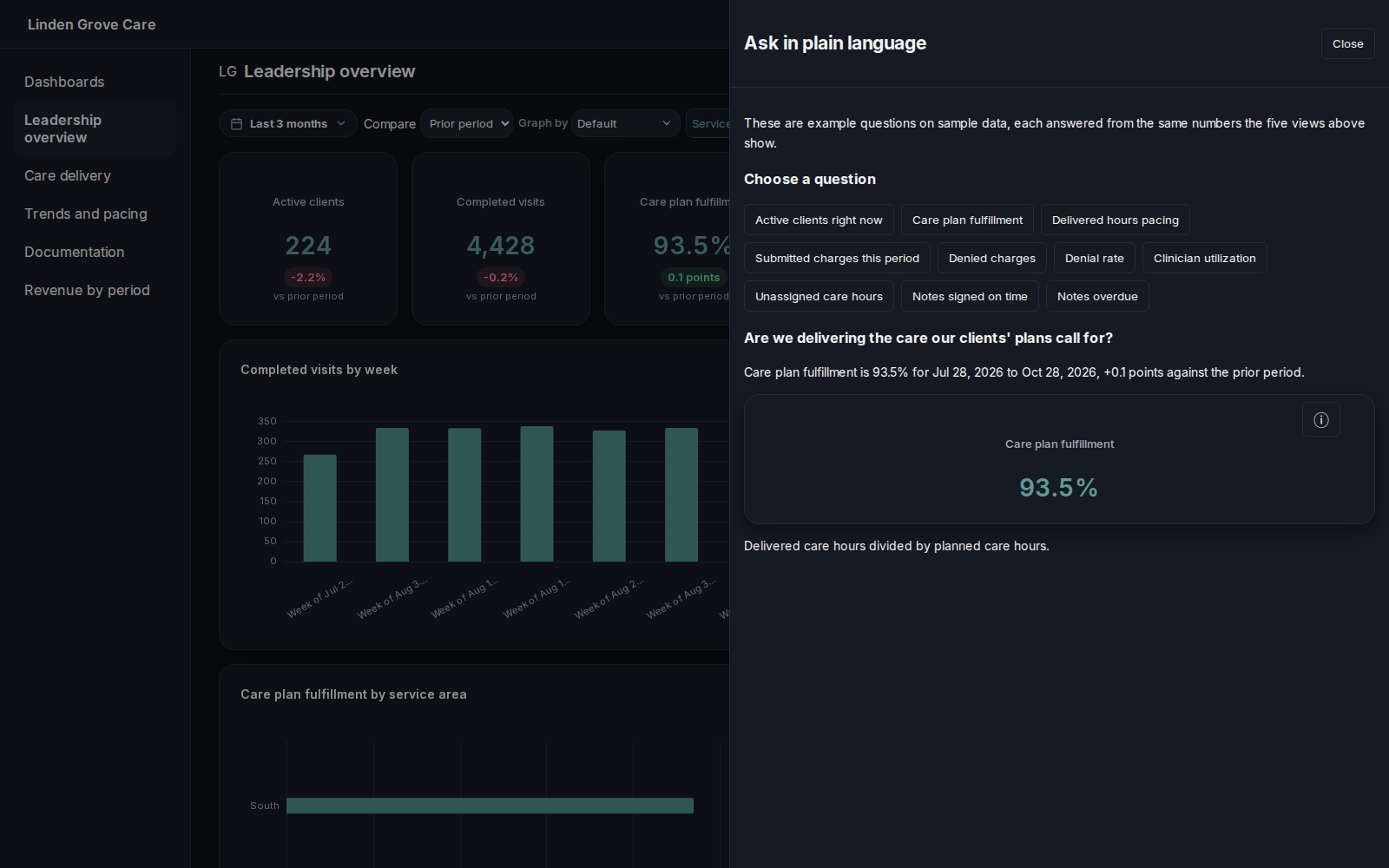
Ask in plain language
How it works
Newtack brings the data from the systems you run today into one place, the Newtack data foundation. Those systems include:
- EHR encounters and notes
- EHR enrollments and census
- Care planning
- Staffing and payroll
- Billing and claims
- Payer contracts and grants
- Outcomes instruments
Your EHR stays in place and your staff keep entering notes the way they do now.
Start with one view
The work starts with one view, such as Revenue by period before your next rate negotiation. Directors learn that one screen and check it against their own spreadsheets before a second view is added. Where a number differs from a director's spreadsheet, the cause is either a definition or the data entry. A wrong definition is corrected once and stated in that number's information panel. Your staff correct data entry in the EHR. Setup time depends on how many systems the first view draws on and, if you run several agencies, how many of them start with it, and we agree both with you before setting a schedule.
Your staff agree on how each number is defined
Your staff decide whether an enrollment starts when the referral is accepted or at the first service, and whether a service counts on the day it was delivered or the day it was billed. When a rule is wrong, it changes in one place and every view recalculates. When the data entry is inconsistent, you can follow a number down by program, location, and clinician to the single visit or claim behind it and see what has to change in the field.
Every view reads the same numbers
Dashboards, reports, exports, and plain-language questions all read from the same data foundation. Each number has an information panel that says how it is counted and when its data was last refreshed. The figure finance takes to the board for a month is the figure a program director sees for that month.
How the numbers are counted
Care plan fulfillment is delivered care hours as a share of planned care hours. Clinician utilization is delivered care hours as a share of the clinical hours available after leave, closures, and nonclinical time. Average length of stay by program counts only stays that ended in the period. A claim that is corrected and resubmitted counts once, at its latest version. Claims arrive through the clearinghouse later than visits arrive from the EHR, and every number's information panel shows when its data was last refreshed, so you know how current a claims number is before you quote it to a payer.
If you run a Certified Community Behavioral Health Clinic, SAMHSA's 2023 certification criteria require you to report Time to Services, including the average time to initial evaluation, and that measure depends on which contact your staff count as the start of services.
Read more about what a data foundation gives you.
Write to us
"The biggest piece out of all this is partnership and collaboration, and we have that from you guys."
Write to us with a question, or to see how your own systems' data would come together in one place. We will reply and arrange a working session, where we map your systems with you and agree which view comes first.